D24
Flagship ProgramData & AIIntermediate12 weeks
Data Engineering
Data Engineering is a 12-week course teaching you to design, build, and operate production-grade data pipelines. You'll learn ELT/ETL with Python, SQL, and dbt, batch processing with Apache Spark, orchestration with Airflow, streaming with Kafka, and cloud warehousing on Snowflake or BigQuery — aimed at developers and analysts moving from scripts to reliable pipelines.
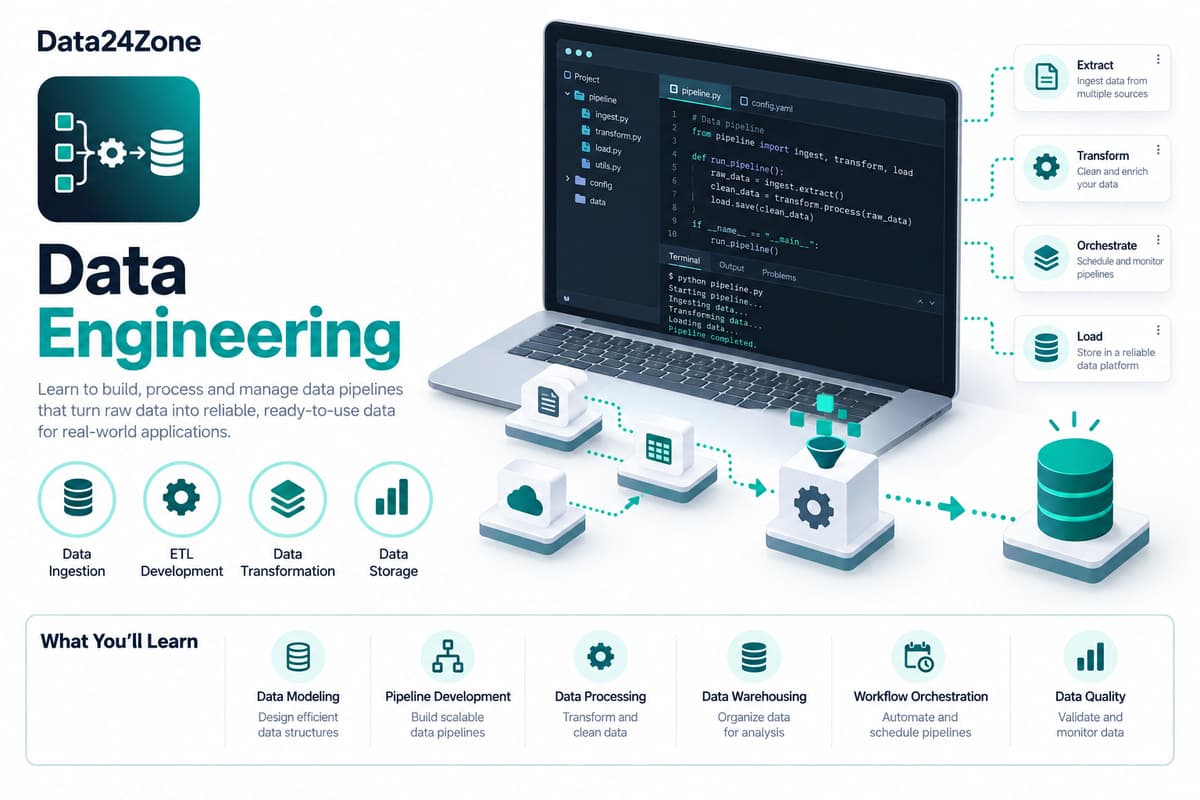
Learn to design, build, and operate production-grade data pipelines — from ingestion and warehousing to distributed batch processing, streaming, and cloud lakehouse platforms.
What you'll learn
Building ELT/ETL pipelines with Python, SQL, and dbt
Batch processing at scale with Spark and workflow orchestration with Airflow
Streaming pipelines with Kafka and cloud data warehousing on Snowflake or BigQuery
Using AI-assisted tooling for schema inference, anomaly detection, and pipeline documentation
Course details
Duration
12 weeks
Best for
Developers and analysts who want to design and operate reliable, production-grade data pipelines
Enrollment isn't open for this course yet — check back soon or contact us.
Course Curriculum
A module-by-module breakdown of what you'll cover in Data Engineering.
01Getting Started & Environment Setup
4 topicsWeeks 1–2
- Installing Python, dbt, and setting up a free Snowflake or BigQuery trial
- Installing Apache Spark (PySpark) locally
- Setting up Apache Airflow and Apache Kafka via Docker
- Verifying your setup by running a trivial PySpark job
02Basic
4 topicsWeeks 3–4
- Dev environment setup, Linux, and Git workflows
- Advanced SQL: window functions and CTEs
- API ingestion, pagination, and idempotent script design
- Working with Parquet, JSON, and CSV formats
03Intermediate
4 topicsWeeks 5–6
- Star and snowflake schema design
- Dimensional modeling with facts and dimensions
- Slowly changing dimensions
- Building and testing dbt models
04Advanced
4 topicsWeeks 7–8
- Batch vs. streaming ETL patterns
- Incremental loads, CDC, and backfills
- PySpark DataFrame API and joins at scale
- Performance tuning: partitioning, shuffling, and caching
05Pro
7 topicsWeeks 9–10
- Airflow DAG design, dependencies, and retries
- Scheduling, backfilling, and failure alerting
- Kafka producers, consumers, and consumer groups
- Spark Structured Streaming and windowed aggregations
- Snowflake, BigQuery, and Databricks lakehouse architecture
- Query optimization, partitioning, and cost control
- Data validation suites, freshness monitoring, and lineage tracking
06AI Pro
4 topicsWeeks 11–12
- Schema inference from raw files with an LLM
- AI-generated transformation code and SQL review
- Auto-generated pipeline documentation
- Guardrails for reviewing AI-generated code
Tools & Technologies
Hands-on practice with the same tools used by working professionals.
Python
SQL
dbtdbt
ApaApache Spark
ApaApache Airflow
ApaApache Kafka
SnoSnowflake / BigQuery
GreGreat Expectations
Want to learn just one piece first?
Data Engineering bundles all of these into one program — but each is also available as its own standalone course if you'd rather learn (or brush up on) a single skill first.
Need this built for your business instead?
If you'd rather have it done than learn it, our solutions team delivers this work for businesses directly.
Real-Time, Industry-Based Projects
This is project-based learning modeled on real industry scenarios — you'll build portfolio-ready work as you go, not just watch lectures.
E-commerce data warehouse with a dimensional star schema and a Type 2 slowly changing dimension, built in dbt
Real-time clickstream pipeline streaming windowed session aggregates into a lakehouse table with Kafka and Spark
Batch ELT pipeline with automated data-quality gates that halt on schema violations or null-rate spikes
CDC replication pipeline capturing change events from Postgres and syncing them to a cloud warehouse in near real time
Cost-optimized cloud warehouse migration with before/after query-latency and cost benchmarks
Every course includes a guided internship on top of your project work — so you graduate with real experience, not just a certificate.
Communication & Soft Skills
Built into every course, alongside the technical curriculum.
Communication Skills
Practice explaining technical work clearly to teammates, managers, and clients.
Practical AI Skills
Hands-on training in using AI tools well — prompting, everyday workflows, and where AI actually helps versus where it doesn't.
Teamwork & Collaboration
Work in small project teams using real workflows like stand-ups and code reviews.
Problem Solving
Build the habit of breaking down ambiguous problems into clear, solvable steps.
Time Management
Learn to plan, prioritize, and deliver project work against realistic deadlines.
Presentation Skills
Present your project work and results with confidence, as you would to a client.
Resume & Profile Building
Build a strong resume, LinkedIn profile, and project portfolio that recruiters notice.
Interview Preparation
Mock interviews and portfolio reviews to get you ready for real job applications.
Career & Placement Support
100% of students enrolled in Data Engineering get full access to placement support — real tools and guidance, not just a promise. This is support and access, not a guaranteed job outcome.
Resume Builder
A resume auto-built from your real completed projects and certificates, ready to export.
Shareable Portfolio
A public portfolio page showcasing your approved projects, with a link you can share with employers.
Interview Preparation
Guidance on presenting your projects and experience clearly in real interviews.
Peer & Mentor Community
Ongoing access to our learner community for questions, feedback, and support after you finish.
What Your Certificates Look Like
Real, verifiable certificates with your name, Data Engineering, and a QR code anyone can scan to confirm they're genuine — one for completing the course, and a separate one if you take the internship track.
Course Completion Certificate
SAMPLE

 Data24Zone
Certificate of Completion
Illustrative recipient
Your Name Here
Example certificate for completion of
Data Engineering
- Certificate No.
- D24-SAMPLE
- Mode
- Self-Paced
- Duration
- 12 weeks
- Example issue date
- On completion
Sample only — not a real, issued certificate.
Verification is available only on issued certificates.
Internship Completion Certificate
SAMPLE
Data24ZoneCertificate of Internship
Illustrative recipient
Your Name Here
Example certificate for completion of
Data Engineering
- Certificate No.
- D24-SAMPLE
- Mode
- Internship
- Duration
- 12 weeks
- Example issue date
- On completion
Sample only — not a real, issued certificate.
Verification is available only on issued certificates.
Student Reviews
“The Spark and Airflow modules were exactly what I needed to move from writing scripts to building pipelines that actually run reliably in production.”
Arvind Menon
Data Engineer, Fintech Startup
“Building the dbt star schema project end-to-end made dimensional modeling click in a way no tutorial ever had. The streaming module was tough but worth it.”
Sneha Kulkarni
Analytics Engineer
Frequently Asked Questions
What is data engineering?
Data engineering is designing and building the pipelines and systems that collect, move, transform, and store data reliably, so analysts and data scientists can use it. It includes ETL/ELT, data warehouses, orchestration, and data quality.
What is the difference between a data engineer and a data analyst?
A data engineer builds and maintains the pipelines and warehouses that produce clean, reliable data. A data analyst uses that data to answer business questions with queries, reports, and dashboards.
Which tools do data engineers use?
Common tools include Python and SQL, Apache Spark for large-scale processing, Airflow for orchestration, Kafka for streaming, dbt for transformation, and warehouses such as Snowflake or BigQuery — the tools this program covers.
What will I learn in the Data Engineering course?
You'll learn: Building ELT/ETL pipelines with Python, SQL, and dbt; Batch processing at scale with Spark and workflow orchestration with Airflow; Streaming pipelines with Kafka and cloud data warehousing on Snowflake or BigQuery; Using AI-assisted tooling for schema inference, anomaly detection, and pipeline documentation.
What tools and technologies does the Data Engineering course cover?
This course covers: Python, SQL, dbt, Apache Spark, Apache Airflow, Apache Kafka, Snowflake / BigQuery, Great Expectations.
Is the Data Engineering course beginner-friendly?
This is a intermediate-level course, so it assumes some prior familiarity with the subject. It starts with a "Getting Started & Environment Setup" module covering tool installation before the main curriculum.
How long does the Data Engineering course take to complete?
The course is designed to be completed in approximately 12 weeks, depending on your pace.
What enrollment options are available for Data Engineering?
Internship (₹2,499) — Work through real projects with our team and earn an internship certificate (course certificate not included). Self-Paced (₹1,999) — Learn anytime with the full recorded curriculum and community access.
Is there an internship option for Data Engineering?
Yes — the Internship track means working through real projects with our team and earning a separate Internship Certificate.
Will I get a certificate after completing Data Engineering?
Yes. Self-paced enrollment earns a course completion certificate once your final project is reviewed and approved. Internship enrollment earns an internship certificate once your internship projects are approved. Every certificate is publicly verifiable on our website and can be added directly to your LinkedIn profile.
What kind of projects will I build in Data Engineering?
You'll work on real projects such as: E-commerce data warehouse with a dimensional star schema and a Type 2 slowly changing dimension, built in dbt; Real-time clickstream pipeline streaming windowed session aggregates into a lakehouse table with Kafka and Spark; Batch ELT pipeline with automated data-quality gates that halt on schema violations or null-rate spikes; CDC replication pipeline capturing change events from Postgres and syncing them to a cloud warehouse in near real time; Cost-optimized cloud warehouse migration with before/after query-latency and cost benchmarks.
Is placement support included with Data Engineering?
Yes — every enrolled student gets full access to our placement support: resume building, a shareable project portfolio, mock interview preparation, and guidance applying what you've built to real job applications. This is support and access, not a guaranteed job outcome — how quickly it leads to an offer depends on the market and your own effort.